
Cutaneous T-Cell Lymphoma (CTCL) Pivotal Clinical Trial
Clinical Trials.govFDA Approval of Pivotal Phase II Trial:
Safety and Effectiveness of A-dmDT390-bisFv(UCHT1) Fusion Protein (Resimmune®) in Subjects with Mycosis Fungoides: A Phase II Multi-center Randomized Clinical Trial
Diagnosis and Main Inclusion and Exclusion Criteria: All subjects must have mycosis fungoides (MF), diagnosed by morphologic, histochemical or cell surface marker criteria. CTCL subjects with stage IA disease are not eligible for enrollment. Subjects with stage IB/IIB with mSWAT < 50 are eligible provided that they have failed two systemic treatments (this includes electron beam radiation). Subjects with lymph node disease including IIA disease and adenopathy in IIB disease are not eligible. A prior history of bone marrow transplant or HSCT or treatment with Campath is an exclusion. A history of preexisting cardiac disease other than controlled hypertension is an absolute exclusion.
Primary Objective: This study objective is to document the incidence of complete responses compared to oral vorinostat, in a randomized 2-arm trial after a maximum of 12 months of treatment for subjects with stage IB/IIB mycosis fungoides with mSWAT < 50 who have never had lymphoid disease or a prior bone marrow / HSCT transplant.
Secondary Objective: To further explore the toxicity profile of A-dmDT390-bisFv(UCHT1) fusion protein for subjects with mycosis fungoides who have been selected to be free from preexisting cardiac disease and never treated with Campath.
Number of Subjects: Lead-in Dosing: 12 / Randomized: 162
Patients will receive full supportive care during the course of the study. Participation in the study will require IV infusions of the research agent 2 times a day for four days (protocol FDA outpatient approved), as well as frequent outpatient blood draws for the first 30 days. Patients with partial or complete remissions at their 1 month follow up visit will have another follow-up visit on day 60, then every three months for 1 year, followed by annual visits to assess duration of the response.
Identification of a Cutaneous T-Cell Lymphoma (CTCL) Subgroup Experiencing a High Treatment Response Rate1,2 in Phase I Study
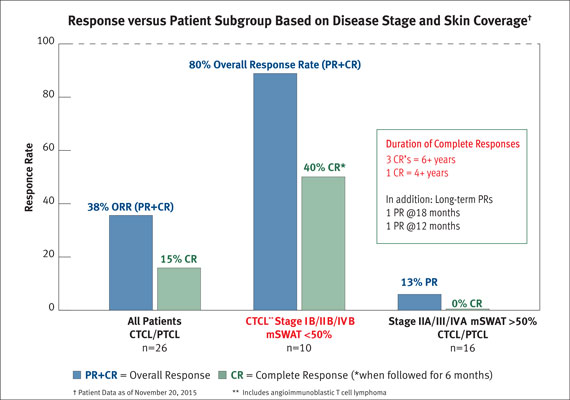
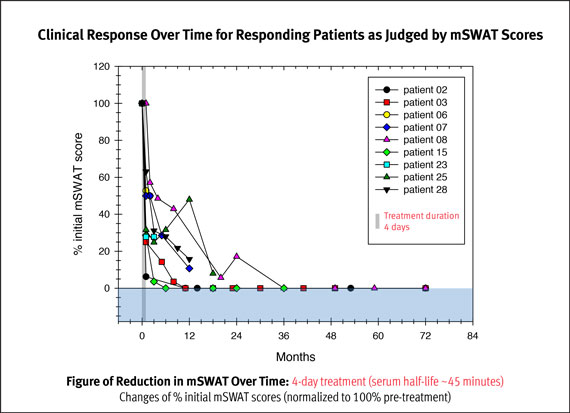
An analysis based on the Clinical Response Data in May, 2015 of the Resimmune® clinical trial showed that there were 26 evaluable patients who received all 8 doses of Resimmune® varying between 2.5 and 11.25 ųg/kg per dose. There were responses at all the lower dose levels. The overall response rate was 38% and the complete response rate was 15% (when followed for six months). If we exclude patients who have mSWAT scores over 50 (50% of skin surface area times a multiplier) and who do not have lymph node involvement or stage III disease we are left with 10 patients. This subgroup has an Overall Response Rate (PR+CR) of 80% and a Complete Response (CR) rate of 40%, three of which are over 72 months duration and may represent cures of CTCL (includes angioimmunoblastic T cell lymphoma). To our knowledge complete responses of this rate and lasting 5-6 years have not been previously reported in any patient treatment subgroup of CTCL with the possible exception of allogeneic HCT (Bloom et al., Curr Treat Options Oncol. 2012 Mar;13(1):102-21). There are advantages to treating patients in this subgroup of stage IB and IIB disease. First, the trade off between efficacy and safety is maximized in this subgroup compared to the larger population of all CTCL patients. Second, patients achieving long-term complete remissions experience benefits from freedom of unsightly painful skin lesions and out of pocket costs for expensive alternate systemic medications that can amount to $25,000 to $100,000 per year. Therefor we propose to focus on enrolling future patients in the
Participate in Trials
New patients will soon be enrolled in the trials above. Please use the contact information and links provided to the right for contacting these centers directly.
Travel & Lodging Defrayment
Angimmune will partially defray travel & lodging costs for a family member to accompany a patient to this trial. Please contact the appropriate Clinical Research Coordinator at the trial site for more information.
Publications and References
1.) Presentation 2013 ASH Annual Meeting: Arthur E. Frankel, Jung H. Woo, Jeremy P. Mauldin, Francine M. Foss, Madeleine Duvic, David M. Neville Jr. "An Update On The Clinical Activity Of Resimmune, a Targeted Therapy Directed To CD3 Receptor, In Patients With Cutaneous T Cell Lymphomas—CTCL". Poster session presented at: American Society of Hematology (ASH). 55th ASH Annual Meeting and Exposition. 2013 December 7-10; New Orleans, LA. Download the Poster PDFTrial Sites:
The Phase II clinical trial is not yet enrolling new participants, pending protocol approvals by clinical site IRBs. This page will be updated as the trial status changes. Angimmune expects to have at 17 sites across the US for the Phase II trial opening in the first quarter of 2017.
University of Texas Southwestern Medical Center
Dallas, Texas, United States, 75390
Principal Investigator:
Arthur E Frankel, MD
Clinical trial contact information:adrian.avila@utsouthwestern.edu Angimmune will partially defray travel costs to this trial site for out-of-town patients.
UTSW Medical Center Trial Information
New Clinical Trial Sites
Please use our contact page if your medical center is interested in participating in this study. This page will be updated when those sites are approved and accepting patients.
Updated 10/25/2016

“Exciting Advances in the Treatment of Cutaneous Lymphoma” is the title of a new article about Angimmune in the latest issue of the Cutaneous Lymphoma Foundation Forum. The article has some interesting background on the founder, Dr. David M. Neville. It details his interest in basic research and developing immunotoxins to treat CTCL and other autoimmune diseases.